


Couldn't load pickup availability

Kisera® Joint Soothing Tart Cherry Extract
When will I start seeing results, and how do I use it?
When will I start seeing results, and how do I use it?
Take two capsules daily. That's the whole protocol.
As for what to expect:
In 3–7 days, the low-grade inflammation you've been living with starts to quiet. Most people notice it as a subtle shift — the morning stiffness isn't as locked. The ache you'd stopped noticing because it was always there feels a degree softer. Some people sleep deeper the first few nights before they notice anything in their joints.
In 2–4 weeks, the changes become something you can point to. Your hands cooperate in the morning. Your knees don't announce themselves on the stairs. The 3 AM wake-ups become less frequent. You start doing small things you'd quietly stopped doing — and you notice because you didn't have to think about it first.
In 6–12 weeks, this is where the deeper shift shows up. The inflammatory signal that's been running unchecked for years has been steadily quieting. Clinical research showed measurable reductions in inflammatory markers within this window. Most people say somewhere around week 8 is when someone else notices first — a spouse, a friend, a doctor who looks at your labs and says something they haven't said before.
How is this different from tart cherry juice?
How is this different from tart cherry juice?
A single glass of tart cherry juice contains over 30 grams of fructose. When your liver processes that much fructose at once, it depletes your cellular energy reserves and produces waste your body converts directly into uric acid and inflammatory compounds. The juice delivers the beneficial anthocyanins wrapped in sugar that actively works against them. Kisera removes the fructose entirely — zero sugar, zero glycemic penalty — so the anthocyanins reach your inflammatory pathways without the metabolic sabotage that makes the juice work inconsistently or make things worse.
How is this different from other cherry supplements?
How is this different from other cherry supplements?
Most cherry supplements on the shelf are made from sweet cherry (Bing, Rainier) — a different species with a fraction of the anthocyanin concentration. The ones that do use tart cherry are typically processed with high heat to reduce manufacturing costs. Heat destroys the anthocyanins — the exact compounds responsible for the anti-inflammatory effect. What remains in the capsule is cherry-flavored powder with little to no biological activity. Kisera uses only verified Montmorency tart cherry, cold-extracted to preserve the anthocyanins intact, concentrated to match the doses used in published clinical research.
Will this help with my specific condition?
Will this help with my specific condition?
Kisera works on the inflammatory pathway itself — specifically the COX enzymes that drive your body's inflammatory response. Whether that inflammation shows up as joint stiffness, gout flares, disrupted sleep, or general achiness, the underlying enzyme pathway is the same. We don't claim to treat or cure any specific condition. What we can tell you is that the anthocyanins in Montmorency tart cherry have been studied for joint comfort, uric acid management, sleep quality, and inflammatory markers — and the 90-day guarantee means you can see for yourself whether it makes a difference for your body without risking anything.
Is this safe to take every day?
Is this safe to take every day?
Montmorency tart cherry has been consumed for centuries and studied extensively in clinical settings. Kisera is third-party tested and contains no artificial additives or fillers. If you are currently on any prescription medication — especially blood thinners, blood pressure medication, or gout medication — we recommend checking with your pharmacist or doctor before adding any new supplement. The call takes two minutes and gives you peace of mind.


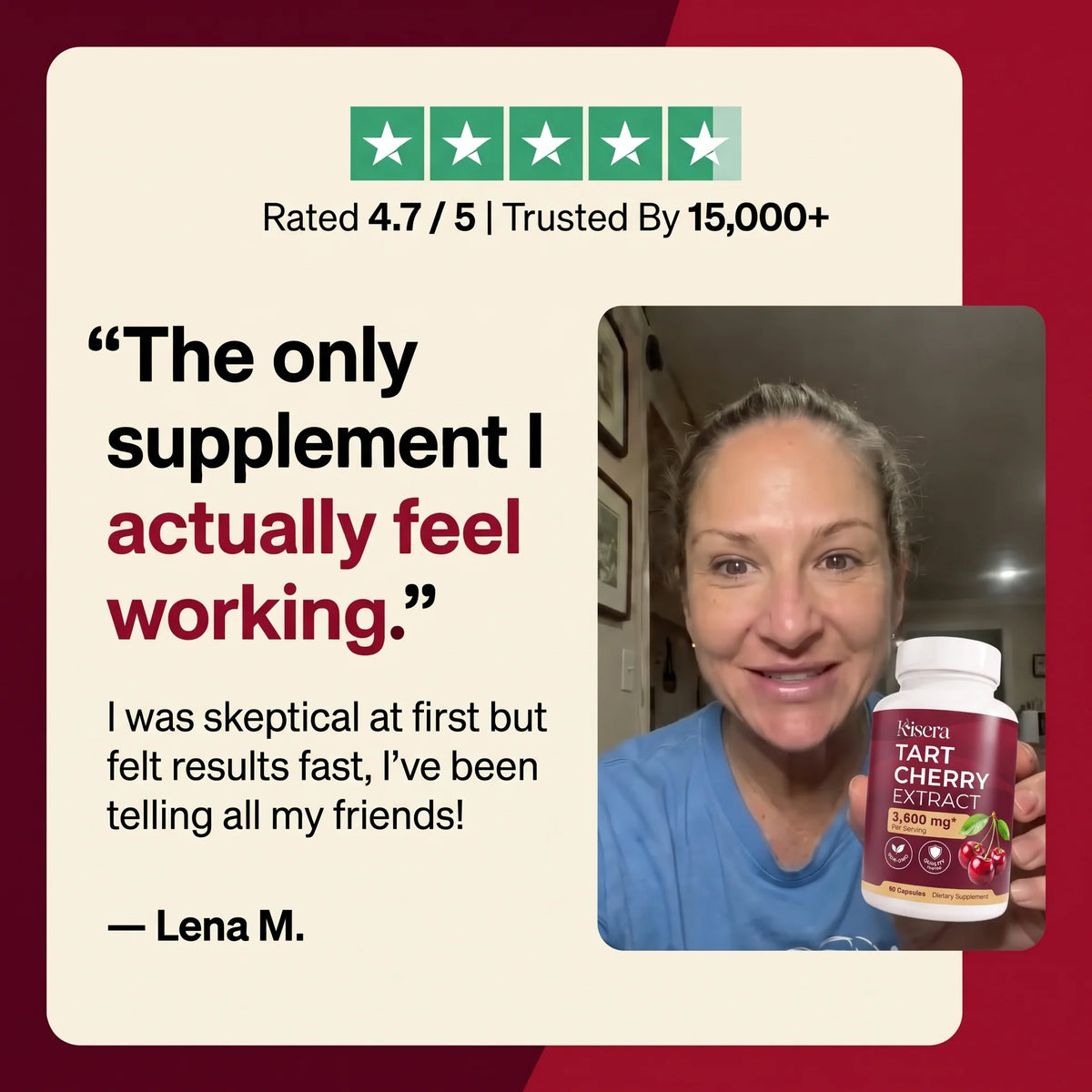
Why Thousands Trust Their Daily Routine
-

"I sleep through the night now. I forgot what that felt like."
"I haven't slept past 3am in two years. I'd wake up with my mind racing and just lie there until the alarm went off. I tried melatonin - it gave me nightmares so vivid I was afraid to fall asleep. I tried magnesium, valerian, CBD, the Sleepy Girl Mocktail with cherry juice. The juice actually made it worse - I'd crash hard and then wake up at 3am like clockwork. My naturopath mentioned that the sugar in the juice triggers a cortisol spike in the middle of the night. That's when I switched to Kisera. No sugar. No crash. By week two I slept until 5:30 for the first time in months. By week six I was sleeping through to my alarm. My husband noticed before I said anything. He said I'd stopped tossing." -

"First time in three years I didn't dread getting out of bed."
"After my breast cancer treatment I was put on an aromatase inhibitor. The joint pain started within weeks. My oncologist said it was a known side effect and that managing it was part of the process. I tried Tylenol. I tried warm baths every morning. I tried turmeric. Nothing touched it. My knees, my wrists, my fingers -every morning felt like I'd aged thirty years overnight. I couldn't crochet anymore. I couldn't pick up my granddaughter. A woman in my support group on Breastcancer.org mentioned Kisera and said it helped her without interfering with her medication. I checked with my oncologist first. She said it was fine to try. By week three the morning stiffness started easing. By week eight I picked up my granddaughter for the first time in a year. I cried in the kitchen. She thought I was sad. I wasn't." -

"My rheumatologist asked what changed. I just showed him the bottle."
"I've had osteoarthritis in both hands for six years. I was taking 800mg of ibuprofen every morning just to open a jar. My doctor said it was wear and tear and I should expect it to get worse. I'd tried glucosamine for a year nothing. Turmeric capsules for eight months -nothing. Cortisone shots that lasted three weeks and came with a lecture about not doing them too often. I found Kisera after my daughter sent me an article about anthocyanins and COX enzymes. By week four I stopped reaching for the ibuprofen before I realized I'd stopped. By week ten I was back in my garden pulling weeds with my bare hands. My rheumatologist looked at my inflammatory markers and asked what I'd changed. I showed him the bottle. He said keep doing it."


Your Body Isn't Failing You. The Inflammation Just Won't Shut Off.
You've tried the supplements. You've taken the pills. You've changed your diet and pushed through the mornings and told yourself this is just what getting older feels like.
And nothing changes.
Not because the products are bad. Not because you're not trying hard enough.
Because everything you've tried works on the surface — and the problem isn't on the surface.
Your body has an inflammatory response system. When something is damaged or stressed, it sends out chemical signals — little messengers that tell the area to swell, stiffen, ache. That response is normal. It's how you heal.
The problem is the messengers don't always know when to stop.
After years of stress, wear, metabolic load, and oxidative damage, the inflammatory signal gets stuck in the "on" position. It keeps firing for a problem that isn't as big as your body thinks it is — or for a problem that was resolved years ago. Your joints keep swelling. Your sleep keeps breaking. The ache keeps coming back every morning.
That is not aging. That's a signal that won't shut off.
NSAIDs like ibuprofen shut the signal off for a few hours by blocking the COX enzymes driving it. But they do it bluntly — and every day you take them, they quietly damage your stomach lining, your kidneys, and your liver. You're trading one kind of damage for another.
Cherry juice tries to deliver the compounds that calm the signal naturally. But a single glass carries over 30 grams of fructose — and when your liver processes that much sugar at once, it produces inflammatory byproducts and uric acid that make the problem worse. The medicine is in there. The sugar cancels it out.
Generic cherry capsules try to concentrate the compounds without the sugar. But most are processed with high heat that destroys the anthocyanins before the capsule is even sealed. What's left is powder with a cherry label and no biological activity.
The anthocyanins in Montmorency tart cherry — specifically a compound called cyanidin — are what block the COX enzymes naturally. The same pathway your NSAIDs target. The same shut-off switch. Without the stomach erosion. Without the kidney strain. Without the liver damage that accumulates silently over years of daily use.
But the compound has to be intact when it reaches you. That means the right cultivar — Montmorency, not sweet cherry. Cold-extracted — not heat-processed. Concentrated to match what was actually used in the clinical research. And zero sugar — no fructose undermining the mechanism while you're trying to use it.
That's what Kisera is. The signal delivered where it needs to go. In the form that actually works when it gets there.
Not another supplement that sits on the surface. The compound that reaches the enzyme and tells it to stand down.
Key Points
- 97%Of customers reported less morning stiffness within the first 90 days.
- 95%Of the active anthocyanins preserved through cold extraction. Standard heat processing destroys them before the capsule is sealed.
- 98%Of customers report noticeable improvement within the first 90 days, or they get every penny back. No questions asked.

"Why Nothing You've Tried Gives You Real Relief And What Actually Does"
Your body runs on inflammatory cycles. When the COX enzyme pathway is active, it drives the swelling, the stiffness, the pain, the disrupted sleep. When it quiets down, your joints move. You rest. You feel like yourself.
Every product you've tried has failed to reset that cycle. Here's why.
That's why NSAIDs don't fix it. Ibuprofen and naproxen block COX enzymes for a few hours. The relief is real — but temporary. And the mechanism they use to block inflammation also strips the protective lining from your stomach, stresses your kidneys, and strains your liver.
After years of daily use, you're managing one problem by creating three new ones.
That's why tart cherry juice doesn't fix it. The anthocyanins in the juice do target the COX pathway. But the 30+ grams of fructose in every glass forces your liver to burn through ATP, producing uric acid and inflammatory byproducts as waste. The therapeutic compounds arrive alongside the exact metabolic signals that keep the inflammation running. The faucet and the drain are open at the same time.
That's why glucosamine and turmeric don't fix it. Glucosamine attempts to rebuild cartilage structure — but if the inflammatory signal destroying the cartilage is still firing, rebuilding is pointless. Turmeric has anti-inflammatory properties but suffers from extremely poor bioavailability — most of it passes through without reaching the COX pathway at meaningful levels.
That's why generic cherry capsules don't fix it. Most are made from sweet cherry — wrong species, wrong anthocyanin profile. The ones that use Montmorency are typically heat-processed to cut costs, which destroys the cyanidin compounds before the capsule is sealed. You're swallowing cherry-colored powder. The enzyme never sees it.
Kisera uses verified Montmorency tart cherry — the cultivar with the highest concentration of cyanidin, the specific anthocyanin that blocks COX-1 and COX-2 at the enzyme level. Cold-extracted so the compounds survive processing. Concentrated to match the doses used in published research. Zero sugar. No fructose. No glycemic penalty.
The anthocyanins reach the COX pathway intact. The inflammatory signal that's been running unchecked for years finally has something telling it to stand down. Not by numbing it. Not by forcing it. By giving your body the compound it needs to regulate itself the way it was built to.
Two capsules. Applied like taking a vitamin. The signal delivered where it needs to go.
Not borrowed relief. Not temporary quiet. Your own inflammatory response coming back into balance.
FAQs
Return Policy
Return Policy
We offer a 90-day satisfaction guarantee. If you don't notice a real difference, contact us for a full refund. That's how confident we are in this product.
Customer Service
Customer Service
Have questions or need help?
Our team is here for you.